Diligence

VCs Work for School Teachers

The New York Times awoke to the surge in private market investing yesterday with an article that contributed relevant quotes about why many CEOs prefer to avoid an IPO.  They even found a tech CEO who admitted to being “terrified” of the public markets.  Ouch.  The NYT article can be found here

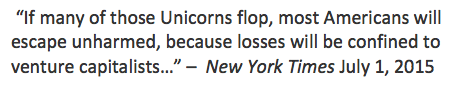
The article highlighted for me how often the public –  and even experienced journalists – forget the fundamental structure of our industry.  The NYT writes:

Screen Shot 2015-07-02 at 10.30.11 AM

The author, and much of the population, are forgetting the basics.

(more…)

Tech Market Update – Gartner CEO Summit

Include PE Buyers in your M&A Process Curious Incident of the Disappearing IPO

Our friends @Gartner_Inc invited me to speak yesterday at their Annual CEO Summit. I met some interesting people. Two of the speaking Analysts are leading projects around B2B buying processes and behaviors. Gartner has done some interesting analysis here, including creating a framework of Enterprise Buying Personalities. Worth checking out if you are a B2B marketer.

My segment was an update on the Tech Capital Markets generally, and the fundraising environment in particular. The slides from the discussion can be found here.

While reviewing our market data in preparation for the talk a couple of points jumped out at me:

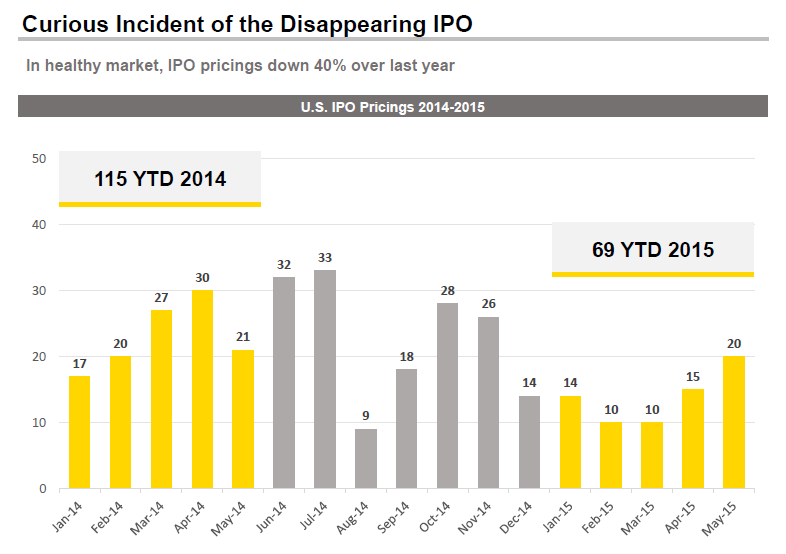
  • The IPO market overall, but particularly in tech, is really off this year. Take a look at the data beginning on Page 12 of the deck. Dan Primack forecasted yesterday in his daily post that we are headed for the lowest number of VC-backed IPOs since the 2009 recession.
  • Public investors like Fidelity may not be crossing over into the private markets in search of outsized returns. They may be doing it as the lack of tech IPOs is offering them fewer alternatives to add new tech names to portfolios.
  • Take a look on Page 22 to see what investors in the latest round for @Snapchat could have bought instead….

Raising Growth Capital? Use a Banker.

Smart companies are adapting as the growth capital market has evolved

Disruptive tech companies are good at product and business model innovation, but they can be just as guilty as a Cleveland steel mill of “way we’ve always done it” operating behavior.  One behavior that puzzles me is the CEO or Board that has not adapted its funding plans to the shift in the private capital markets.  25 years ago venture capital and growth equity may have been the same market, best accessed with the same process, but today they are different markets that require different thinking and different processes.

(more…)

Your VC’s Cap Table Math Could be Hurting You

This post includes some geeky accounting issues, but read it. It can change how much dilution you take in the next round.

Later-stage investors are delivering our companies attractive valuations. Just look at the latest Unicorn list.

However, many companies are not really getting the headline valuation in their term sheet. Ultimate ownership and dilution is driven by pre-money share price, not a headline valuation. When follow-on investors are calculating share price, many use an outdated method that is adding dilution to existing shareholders, most often hurting founders and employees.

(more…)

Customer Diligence Requests

cell-phone-annoyed-hed-2014If you sell to the enterprise and are raising capital, you need a plan for interacting with your key customers during the raise.  Potential investors want to talk with a young company’s customers to validate the customer’s intent to keep buying the product or service. However, management lives or dies with its key customers. It needs them for larger future purchase orders and prospective customer references. Asking customers to take prospective investor calls, often from multiple investors, is spending precious relationship capital.

Investors tend to be curious and skeptical types. The questions they ask about how the customer views the capabilities of the team or its products might cause the customer to view the company differently.  What happens if the company does not come to terms with an investor? The customer is then wondering about vendor viability if a funding is not announced.  The type of investor you want will respect the value of customer time and confidence. However, investors need to do this diligence to assess risk before investing.  Managing customer conversations to everyone’s satisfaction is tricky, but we have a few suggestions that have proven helpful.

(more…)

Reverse Diligence on Investors

Reverse Diligence on InvestorsWe raise growth capital for tech companies, so I spend a lot of time with CEOs trying to choose between Firm A and Firm B as an investor.   I wrote an initial post on questions a CEO should be asking directly of a General Partner wanting to invest in the company. In this follow-up I share some questions to be asked when talking with external references.

The most valuable source of discovery is discussions with CEOs where your prospective boss has been an investor / Director. Request a few references. Any reputable investor will have them at the ready. Most will be surprised and disappointed if you do not ask.

Pursue the offered conversations, but also dig around on your own to find references not offered. A LinkedIn or Crunchbase search of current and former portfolio companies will turn up a few former senior executives. You may even find executives who were fired by the investor. Some references will share complaints over issues they brought on themselves, but you can usually filter the feedback and learn from it.

A few good questions for portfolio executives regarding how your prospective investor behaved include:

(more…)
Diligence is a Two Way Street


174440819-resized-600.jpg-300x200We raise growth capital for tech companies, so I spend a lot of time with CEOs who are choosing a new investor from between Firm A and Firm B.  Picking your investors is a critical decision that has long-term consequences.  Given the investors are often future Board members; you may be hiring your boss.

While the investors are busy scrubbing your background with calls to former colleagues, customers and classmates, you need to make time to do the same to them.  The sources of information on your potential investor include: (i) the investor, (ii) the references the investor provides (usually happy portfolio CEOs) and (iii) references you discover (often less happy portfolio CEOs).  In this post I will discuss the first group.  I will follow this with a future post on questions for portfolio executives.

(more…)