It’s different now! The economics have changed. Open source and the cloud stack allow talented people with an idea to build a company for pocket change. No need to buy servers to create a development and test environment. Just rent space on AWS. Use temporary offshore resources to do QA. No need for salespeople. Put the product on the web and let the customer download. Use a freemium model to get users hooked. No need for brand investment. Debut at SXSW then tweet six times a day about your product. No need to spend months courting venture investors. You can build a company for what you spent last month on beer and Red Bull.
It makes for a great rap from the dais during the conference panel.
Unfortunately, it’s not true.
Take a look at the company validation events from last year. The data affirm that it still takes capital to build a company.
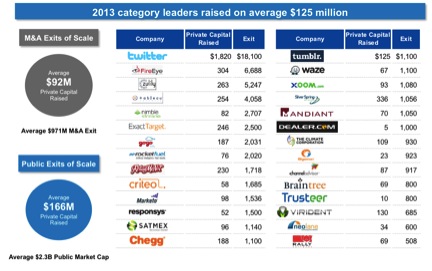
As the chart details, 28 companies reached a $500 million market validation in 2013. The companies that reached the milestone raised, an average (adjusted for outliers like Twitter and Dealer.com) $129 million in private capital. Most of them likely also consumed a few more million in debt. We don’t have data to know how much of the equity raised was primary capital, but the investment requirement pattern is still clear. Admittedly, our $500 million threshold is arbitrary. Shareholder value can be created at a variety of outcomes. However, $500 million represents a reasonable milestone for market recognition of a sustainable company, rather than just an interesting product (cue your Snapchat at $3 Billion comments…).
Conference panelists preaching the efficiency of the LAMP stack and cloud revolution are not wrong, they are simply substituting the cost of building a product for the cost of building a company. It is less expensive now to build a product. That is a great thing. More experimentation and learning is happening as it has become cheaper to fail. However, building and scaling a company is still expensive and will likely continue to stay high.
The consumer may still be leading the evolution and adoption of tech products, but consider what it costs to build a consumer brand. The young company is competing for consumer attention with brands funded by the cash hoards at Apple, Microsoft, Google, Samsung, Amazon and an invigorated Yahoo. There are plenty of success stories, but those that did not invest millions in brand awareness are rare. Scaling consumer business requires expensive, experienced people to arrange distribution deals. It also means expensive attorneys to comply with complex privacy regulation around the identifiable user data.
In the enterprise market the need for investment capital to scale a business is even more dramatic. The shift to cloud platforms has allowed purchasing decisions for technology solutions to be made increasingly by managers outside the IT department. These managers do not have the decades of tech buying experience found in IT. A new vendor wishing to gain mind share needs the staff and funds to create awareness and cut through the noise at industry trade events. Whatever your product does, someone needs to train the users. You also need salespeople to explain it all to your prospects. Even those inside sales teams cost money.
Just build a cool product; the rest will take care of itself. It’s an attractive and enduring myth, but it’s a myth. Having even a great product find its way to enough customers to realize its potential requires building a company. If you think you have a billion dollar idea, you still need to get to know those pesky venture capitalists. Having capital does, of course, not guarantee success. However, successful execution without capital is not likely.
 Raising the Next Round